
Is Hungarian Hard to Learn?

Is Hungarian Really That Hard to Learn? Let's Find Out.
Hungarian is often labeled as one of the hardest languages to learn. But is that reputation deserved, or is it more myth than reality? Spoiler: it’s challenging—but not impossible. Sure, with 18 grammatical cases and a vocabulary that’s worlds apart from English, Hungarian stands out. But that’s also what makes it fascinating. If you’re up for the challenge, I’ve got you covered. This guide breaks down the complexity and gives you practical strategies to conquer Hungarian, one step at a time. Ready to dive in? Let’s do this!
1. Complex Grammar
Hungarian grammar is often seen as intricate and challenging. One of the biggest differences compared to English and most European languages is that Hungarian uses postpositions and case endings instead of prepositions. With 18 grammatical cases, the language allows for a high degree of word flexibility in sentences. Although this sounds overwhelming, many learners find that these cases, while different, follow consistent patterns that become intuitive with practice.
Here’s an example illustrating how Hungarian grammar differs from English, particularly with the use of postpositions and case endings:
In English, we use prepositions like in, on, at, with to indicate relationships between words. For example, the sentence:
- “I am going to the store with my friend.”
In Hungarian, instead of prepositions, postpositions or case endings are used. So, this sentence would be translated as:
- “A boltba megyek a barátommal.“
Let’s break this down:
- Bolt (store) becomes boltba to indicate motion “toward” or “to” the store. The suffix -ba functions similarly to the preposition “to.”
- Barátom (my friend) becomes barátommal, where -mal is a suffix meaning “with,” replacing the preposition “with.”
Hungarian’s use of 18 grammatical cases means words often change form depending on their role in the sentence, but this also allows for greater flexibility in word order. Over time, learners begin to recognize these patterns, making them more intuitive with practice.
2. Agglutinative Nature
Hungarian is an agglutinative language, which means that words are formed by adding prefixes and suffixes to a root word. This process can result in long and complex-looking words that express a lot of information in just a single term. Verbs can be particularly challenging, as they change based on tense, mood, and the subject’s person. However, agglutination also brings consistency, as once you understand how suffixes work, you can apply this knowledge to a broad range of words.
Here’s an example demonstrating how Hungarian agglutination works:
Let’s start with the root word ház (house). By adding prefixes and suffixes, we can create a word that conveys a lot of information all at once.
- Ház – “house”
- This is the root word.
- Házak – “houses”
- Suffix: -ak (plural marker, meaning more than one house).
- Házakban – “in the houses”
- Suffix: -ban (indicating location, meaning “in”).
- Házakban lakunk – “We live in the houses”
- Verb: lakunk (from the root lak meaning “to live,” with the -unk suffix indicating first-person plural, meaning “we”).
- Házainkban lakunk – “We live in our houses”
- Suffix: -aink (possessive marker, indicating “our houses”).
- Combined: Házainkban (in our houses).
So, a single word like házainkban combines the root (ház), plural (-ak), possessive (-aink), and location (-ban) into one long word. While it may seem complex, the system is consistent, and once you know how the suffixes function, you can apply the same logic to many other words!
3. Vowel Harmony
Vowel harmony is another unique feature of Hungarian. Vowels in a word must harmonize, meaning they follow certain patterns based on their phonetic qualities (front, back, rounded, or unrounded). This impacts how suffixes are attached to words, so understanding vowel harmony is crucial to getting suffixes right.
Here’s an example illustrating how vowel harmony works in Hungarian:
Hungarian vowels are categorized into two main groups: front vowels (e, é, i, í, ö, ő, ü, ű) and back vowels (a, á, o, ó, u, ú). The suffixes you add to a word must match the type of vowel in the word. This means if a word has back vowels, you use back vowel suffixes, and if it has front vowels, you use front vowel suffixes.
Take the word ház (house), which has a back vowel:
- Házban – “in the house”
- Suffix: -ban (because ház has a back vowel, the suffix -ban is used for location).
Now, consider the word szék (chair), which has a front vowel:
- Székben – “in the chair”
- Suffix: -ben (because szék has a front vowel, the suffix -ben is used for location).
So, the difference between -ban and -ben depends on the vowel harmony of the word. Vowel harmony ensures that the word and its suffixes sound natural and fluid when spoken. Understanding this system is key to constructing words correctly in Hungarian!
4. Unfamiliar Vocabulary
Since Hungarian doesn’t belong to the Indo-European language family, its vocabulary differs significantly from languages like English, Spanish, or French. You won’t find many familiar words, and the distinct roots and word formations will require extra effort to memorize.
Here’s an example illustrating how Hungarian vocabulary can be quite different from Indo-European languages like English, Spanish, or French:
Let’s compare some common words in Hungarian and their counterparts in English and Spanish:
- Water
- English: water
- Spanish: agua
- Hungarian: víz
- Book
- English: book
- Spanish: libro
- Hungarian: könyv
- Friend
- English: friend
- Spanish: amigo
- Hungarian: barát
As you can see, Hungarian words like víz (water), könyv (book), and barát (friend) don’t resemble their English or Spanish counterparts at all. This is because Hungarian belongs to the Uralic language family, which has entirely different linguistic roots compared to Indo-European languages.
This means that when learning Hungarian, you won’t find the familiar cognates that often help learners of Romance or Germanic languages. Instead, you’ll need to put in extra effort to memorize completely new word forms and roots, making the vocabulary distinct and often challenging for learners coming from Indo-European languages.
5. Pronunciation Challenges
While Hungarian pronunciation is generally phonetic—meaning each letter corresponds to one sound—some sounds are tricky for non-native speakers. For instance, the “gy” sound or the “sz” combination can be difficult to master without exposure and practice.
Here’s an example demonstrating tricky Hungarian pronunciation:
Hungarian is mostly phonetic, but certain sounds can be challenging for non-native speakers, especially when they don’t exist in English or other familiar languages.
- Gy sound:
- The gy sound in Hungarian is similar to the English “d” followed by a soft “y,” as in “due.” For example:
- Gyerek (child) is pronounced like “dyereck.”
- Hegy (mountain) is pronounced like “hedd-y.”
- The gy sound in Hungarian is similar to the English “d” followed by a soft “y,” as in “due.” For example:
- Sz sound:
- In Hungarian, sz is pronounced like the English “s,” not “z.” For example:
- Szép (beautiful) is pronounced “seyp.”
- Szó (word) is pronounced “so.”
- In Hungarian, sz is pronounced like the English “s,” not “z.” For example:
- S sound:
- On the flip side, the letter s in Hungarian is pronounced like the English “sh.” For example:
- Szeret (to love) is pronounced “se-ret.”
- Sétál (to walk) is pronounced “shay-tal.”
- On the flip side, the letter s in Hungarian is pronounced like the English “sh.” For example:
These subtle differences in sounds like gy, sz, and s can be difficult to master without consistent exposure and practice, as they don’t have direct equivalents in English.
How to Overcome the Challenges and Learn Hungarian
Despite its reputation, learning Hungarian doesn’t have to be insurmountable. With the right strategies and mindset, you can make steady progress and even enjoy the process of unlocking this beautiful language.
1. Start Small with the Basics
As with any language, mastering the basics of Hungarian will set you up for success. Begin by learning the foundational grammar rules, such as verb conjugations, noun cases, and vowel harmony. Focus on building a solid understanding of these principles before moving on to more complex concepts.
2. Immerse Yourself in the Language
One of the best ways to learn Hungarian is through immersion. Surround yourself with the language by listening to Hungarian music, watching movies, or tuning in to Hungarian podcasts. This not only improves your listening skills but also helps you develop a feel for the natural rhythms and patterns of the language.
3. Don’t Shy Away from Speaking Early
Speaking from the start is essential to becoming comfortable with Hungarian. The earlier you practice speaking, the faster you will overcome the intimidation of making mistakes. Find a language partner or use apps that connect you with native speakers to practice conversations. The more you speak, the quicker you will adapt to the language’s nuances.
4. Focus on Vocabulary Building
Hungarian’s unfamiliar vocabulary requires extra attention, so start building your word bank early. Flashcards, spaced repetition systems (SRS), and vocabulary apps can help reinforce new words. Try to learn vocabulary in context, such as through sentences or phrases, so you can understand how words fit into everyday conversations.
5. Engage with Hungarian Culture
Learning a language becomes more rewarding when you connect it with the culture. Explore Hungary’s rich history, traditions, and cultural expressions. By understanding the cultural context behind certain expressions, idioms, and phrases, you’ll find yourself more motivated to learn.
The Importance of a Native Hungarian Teacher
Having a skilled native speaker as your teacher can dramatically accelerate your progress in Hungarian. While language apps and textbooks are useful, nothing beats real-time feedback and personalized instruction. Here’s why a native teacher is invaluable:
– Nuance and Subtlety: A native teacher can help you grasp subtle cultural references, colloquialisms, and expressions that textbooks might miss.
– Immediate Feedback: Correcting mistakes as they happen is crucial to avoiding bad habits in grammar and pronunciation. A teacher can offer immediate corrections to keep you on track.
– Customized Learning: Everyone learns differently. A good teacher can tailor lessons to suit your learning style and pace, ensuring that you fully understand each concept before moving on.
– Speaking Confidence: Speaking Hungarian regularly with a native speaker in a supportive environment builds confidence and helps you practice the flow and tone of the language naturally.
Personalized Hungarian Lessons with Connecting Hungary
Are you looking to learn Hungarian to reconnect with your heritage, enhance your career prospects, or gain Hungarian nationality through simplified naturalization? Learning Hungarian is not only a rewarding journey, but it also opens up cultural and professional opportunities. At Connecting Hungary, I provide personalized Hungarian lessons designed to help you master the language effectively and enjoyably.
I’m an experienced native Hungarian teacher, offering online Hungarian lessons tailored to your needs. Whether you’re a beginner looking to grasp the basics or someone wanting to deepen your understanding, my online Hungarian lessons will give you the tools and confidence to navigate the complexities of the Hungarian language. My approach focuses on simplifying difficult concepts like grammar and pronunciation, making it easier for you to progress.
Free Hungarian Flashcards to Kickstart Your Learning
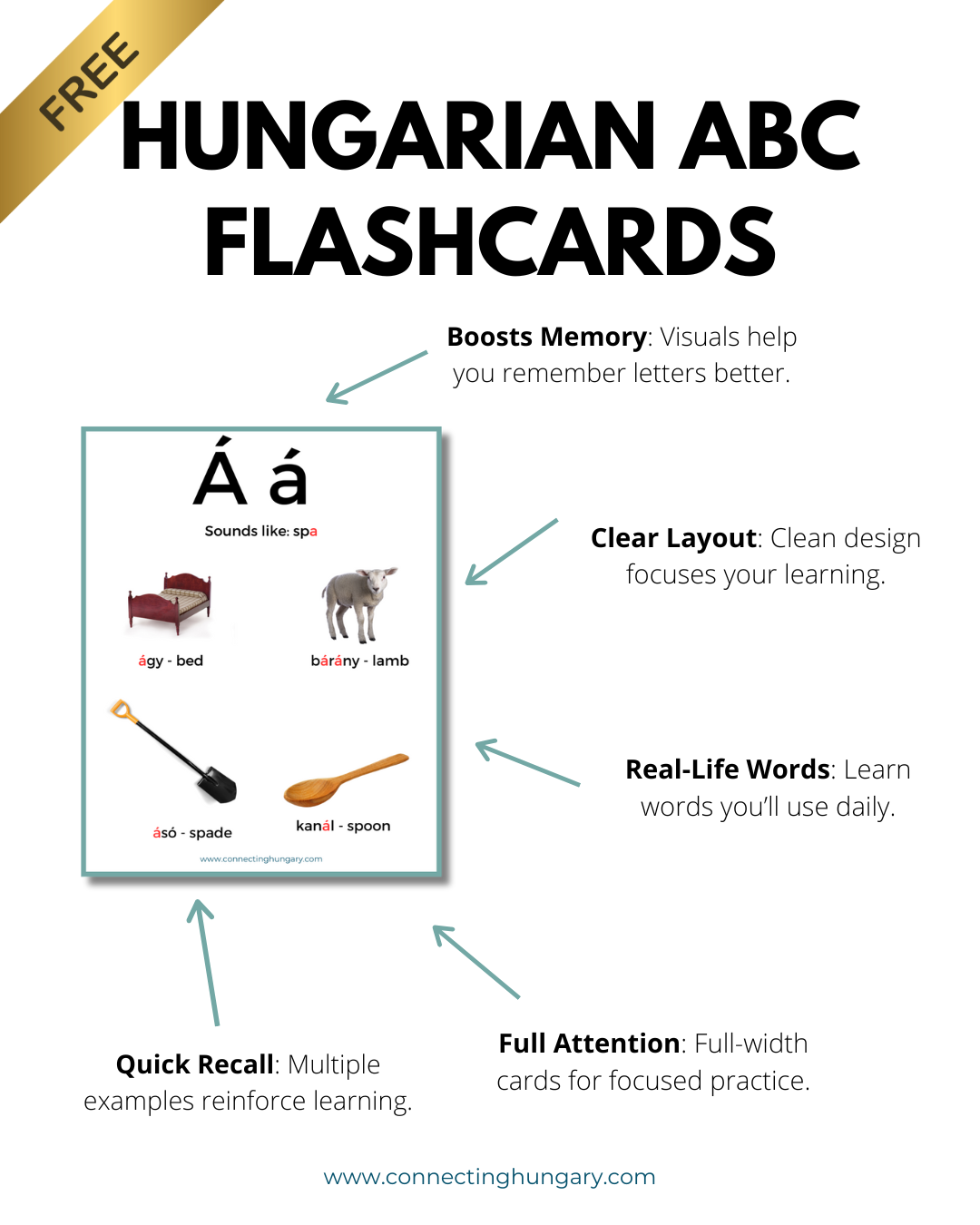
If you’re just starting out and find the Hungarian alphabet intimidating, don’t worry—my Hungarian Alphabet Flashcards are available for free download. These flashcards are perfect for beginners who want to get a head start in learning the Hungarian alphabet. With each flashcard focusing on a letter and providing examples, you’ll soon feel comfortable with the basics and be ready to advance.
By using these Hungarian flashcards alongside your lessons, you’ll quickly familiarize yourself with the Hungarian alphabet, giving you a strong foundation to build upon as you progress through the language.
Hungarian in Comparison to Other Languages
Is Hungarian really the hardest language to learn? It’s true that Hungarian poses unique challenges, but compared to tonal languages like Mandarin or languages with non-Latin alphabets like Arabic or Japanese, Hungarian can be more approachable in some respects. Its consistent phonetic spelling, logical grammatical rules, and lack of complex verb tenses (like those in Romance languages) offer some relief once you grasp the fundamentals.
Staying Motivated in Your Hungarian Learning Journey
Learning any new language is a marathon, not a sprint, and Hungarian is no exception. Staying motivated is essential to long-term success. Here are some tips for keeping yourself on track:
– Set Small Goals: Break your learning into manageable milestones, such as learning a certain number of new words each week or practicing speaking for 10 minutes daily.
– Track Your Progress: Keeping a journal to log your progress can be encouraging. Look back after a few months to see how far you’ve come.
– Celebrate Wins: Whether it’s mastering a tricky pronunciation or completing a difficult conversation, take the time to celebrate your achievements, no matter how small.
Conclusion: Embrace the Challenge of Learning Hungarian
Hungarian is undoubtedly a complex and fascinating language, but with determination and the right approach, it’s far from impossible to learn. Break it down step by step, practice regularly, and immerse yourself in both the language and the culture. By working with a native speaker and utilizing flashcards, you’ll be well on your way to mastering Hungarian and unlocking a new world of communication.
So, is Hungarian hard to learn? The answer depends on your perspective, but with the right strategies, it can be a deeply rewarding experience.
Frequently Asked Questions
1. How long does it take to learn Hungarian fluently?
The time it takes to become fluent in Hungarian varies depending on the individual and how much time they dedicate to learning. For most learners, achieving fluency takes several years of consistent study and practice.
2. Can I learn Hungarian on my own?
Yes, it’s possible to learn Hungarian on your own, especially with the many online resources available. However, working with a native speaker can greatly speed up your progress.
3. What are the most common challenges when learning Hungarian?
Some of the most common challenges include mastering the complex grammar, building a new vocabulary, and getting used to pronunciation differences.
4. Are there any similarities between Hungarian and other languages?
Hungarian has very few similarities with other European languages, as it belongs to the Uralic language family. However, its agglutinative structure is somewhat similar to languages like Finnish.
5. What’s the best way to practice Hungarian regularly?
The best way to practice regularly is through immersion. Engage with Hungarian media, find a language partner, or work with a tutor to practice speaking, listening, and reading regularly.

About Your Hungarian Instructor
My name is Magdolna, and I am your dedicated native Hungarian instructor. Growing up in Hungary, I have absorbed the language, culture, idioms, and subtle nuances that make the Hungarian language truly special. Teaching my native tongue is incredibly rewarding. I believe language is a bridge between cultures and a pathway to new opportunities.
My mission is to help you experience Hungarian in a way that becomes a seamless part of your thought process. Our classes will transcend mere lessons. They’ll be a rich cultural exchange, ensuring your progress, success, and enjoyment.
Book your free briefing call now to learn Hungarian!
Embark on your Hungarian language journey with personalized lessons that cater to your unique needs and goals. Reconnect with your heritage, enhance your career prospects, and open doors to new opportunities with Connecting Hungary. Book your free briefing call now!